I built agents that trace a guest’s claims through interviews, documents and images, then find connections across our archive of people, places, craft and reported beings.
Jesse’s Baltic Sea comparison opens a new lead at Skinwalker.
In his conversation with Brandon Fugal, Jesse connects the ranch’s equipment failures with the Baltic Sea Anomaly near the end. Dennis Åsberg’s Baltic interview adds repeat GPS failures on another boat; sonar imagery opens a second, visual line of comparison.
I would build on moments like this before and after each episode, adding deeper source research and visual comparisons to the team’s preparation. The central question stays the same: what is beneath the ranch, and which evidence would help identify it?
01
Trace Fugal’s claims to their original sources.
The starting points are his earlier interviews, the ranch team and the specialists who produced its survey data. Agents extract the named people, claims, measurements and images, then follow the references between them.
Each statement becomes a linked record: person, claim, place, date and supporting material.
02
Match the guest’s evidence with the American Alchemy archive.
The archive gives each new claim a wider context. A failure reported at the ranch can lead to an earlier interview, a second location, or a document that helps explain what to test next.
127 earlier groups selectedFocal family + undated groups held out
194 people · 71 sites19 craft forms · 20 being categories
Trace the original sourcePeople, records and dated accounts
Compare the guest’s findingsEquipment effectsShape and dimensionsReported occupantsDates and source chains
Guest evidenceRanch measurements and accounts
+
Earlier archive127 eligible episode groups
→
Research leadsBaltic · craft images · occupants
Three parallel research agents extend the matches with original documents, video passages and community observations. The combined main packet contains 86 sources.
03
Which places share Skinwalker’s reported effects?
The first comparison follows Jesse’s clue: equipment failures tied to a location. The Baltic account adds repeat GPS failures on a second boat; other sites help us compare individual effects.
Homestead 2’s reflectors are discussed around 8–30 ft (2.4–9.1 m). The mesa’s separate reported lateral extent is about 400 ft (122 m). At the ranch, 1.6 GHz is a reported received signal; 45 MHz is the later borehole radar’s operating frequency. A corresponding Baltic spectrum remains a data request.
05
Could the ranch target also have an open-sided outline?
The Baltic plan view gives us a distinctive search feature: a rounded outline with an inset. Aleksei’s contour proposes a corresponding recess in the ranch profile. That is the next geometric hypothesis to test.
A georeferenced grid of crossing radar lines, velocity calibration and horizontal depth slices would let us test the proposed recess. Ask the team for the original traces and processing settings before the next conversation.
Levenda supplies the archive’s explicit C-shaped comparison.
The bars count episode groups containing each term across the 136-group working archive. The C-shaped passage leads into the Horten records below.
Saucer81
Orb54
Tic Tac42
Triangular / triangle-shaped22
C-shaped1
06
Four leads from the C-shaped search.
The shape search branches into two modern image cases and two historical records. Each adds a different clue: a possible location, nearby lights, an aircraft-design trail or an early witness description.
The clip shows a bright open-sided form across several frames.
Greer later relays a claimed downing outside Seoul; Coulthart separately describes a built-over object outside the US.
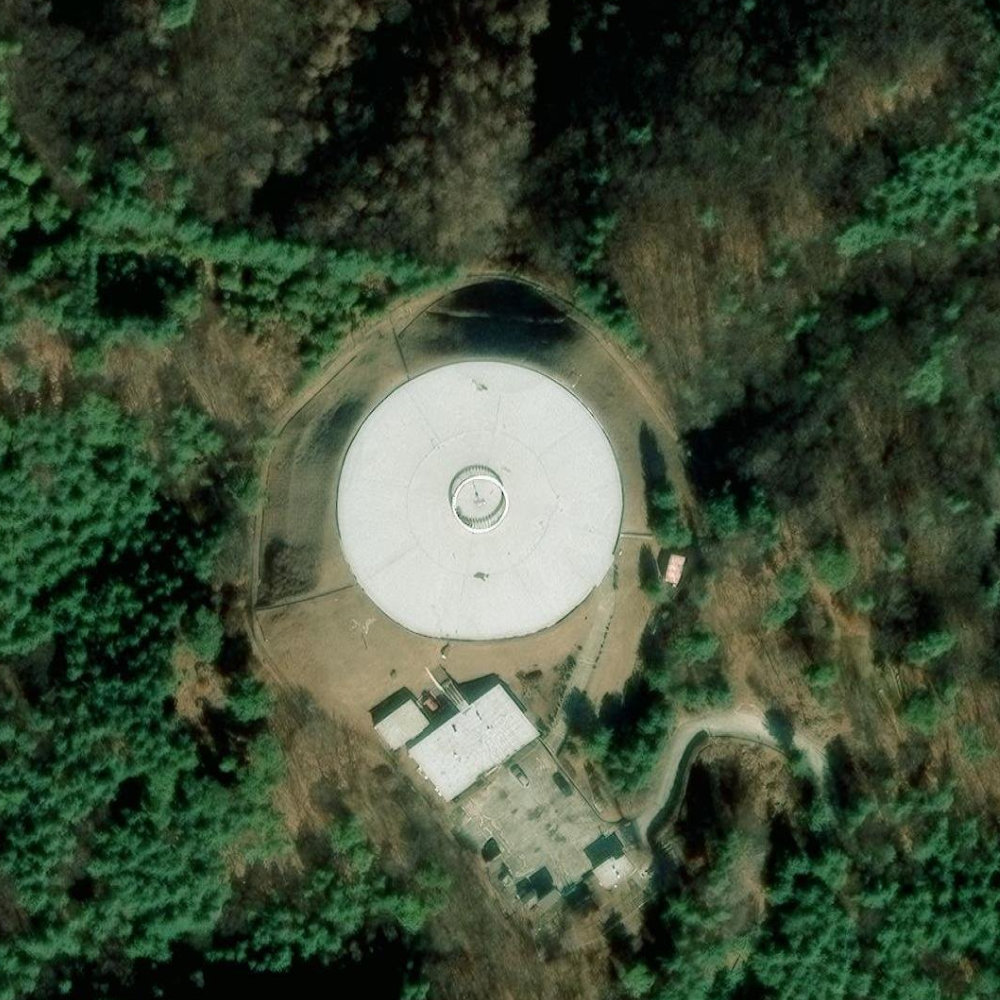
The community’s Yangju candidate has a platform about 71 m across. It was in service in 1999—before this footage.
The proposed site and its timeline
Yangju’s construction dates to 1996–98. Its published role is a VOR/DME station. A source naming the exact recovery site would connect the building claim to a location.
The annotation is an enlarged crop from the same photo family. The contributor also supplies separate Colorado screenshots from two reported occasions.
Arnold’s contemporary report describes nine flying objects and includes a top and side sketch.
The familiar deep crescent comes from a later depiction. His later account discusses one differently shaped object.
The dates of the drawings matter when comparing the outline with modern imagery.
07
Bring the new clues back to Skinwalker.
The research loop asks whether what we learned elsewhere helps explain the ranch. Shape, nearby lights and activity at an opening become separate tests of the same proposed connection.
Nearby lights → ranch footage
The Yukon comment prompts a search for similar behaviour. HISTORY shows a point near the mesa and a separate sequence of thermal targets changing spacing.
Open the two source sequences
The broad halos are programme highlighting. Conventional drones and rockets were part of the experiments; their tracks belong in the comparison.
Ongoing activity → the Baltic opening
Åsberg describes sediment-clouded water moving in and out of a hole, using breathing as an analogy. This gives the follow-up a specific observable process.
Could a buried or submerged system remain active—and could nearby small objects be associated with it? Test repeatable trajectories at the ranch and time-aligned flow, current and temperature records at the Baltic opening.
08
Which occupants are linked to which craft in the accounts?
At Homestead 1, Kaleb Bench recalls a panel-like surface, roughly 5–6 feet across and high, with rippling reflections. That gives the encounter search a starting point. The comparisons below come from accounts describing both occupants and a vehicle.
Account
Reported occupants
Craft described
Research value
First-person account
Blue-tinged humanoid
Two seats; rounded front and dark rear
A repair request and an uneven departure add operational details.
Channeling attribution
Pale human–Grey hybrid, as described by Anka
Triangle with corner lights
Anka links his earlier sightings to Bashar through a later claimed mental communication.
First-person account
Tall Whites
Ellipsoidal scouts, larger vessels and local saucers
Hall distinguishes craft by purpose within the same group.
First-person account
Short humanoids and human-looking figures
Oval craft and a hangar with other vehicles
One narrative includes several occupant appearances and vehicle sizes.
Witness report
Two long-haired humanlike occupants
Domed silver saucer
Occupants are described inside the transparent forward dome.
Secondhand account
Blue-grey figures in the relayed story
Disc with three supports and a ramp
The source trail runs through the people who describe the alleged film.
?
Who—or what—operates the C-shaped candidates?
The reviewed C-shaped records leave the occupants unidentified. If a candidate proves to be a vehicle, it could be crewed, remotely controlled or autonomous. An occupant account tied to that same vehicle would be the next useful link.
Every interview can strengthen the next one.
American Alchemy already brings together an extraordinary archive and a community that notices what others miss. I want to turn that collective knowledge into a growing public research system: source-linked observations, testable hypotheses and better-prepared conversations.
I built this case study in a day on top of an existing archive. I’m applying as a Researcher & Writer to turn these leads into source-backed episode stories, visual comparisons and interview questions—and to develop this system with the team. Imagine what we could build together over the next few years.